Questions to Ask Your Wild Games Camper
If you’re wondering what your camper has been up to this week, here are some questions to get the conversation started…

As the weather warms and you enjoy spring hikes, you might easily mistake it for clover on the forest floor. But this springtime foliage is actually the wild edible wood sorrel. The three-petaled leaves turn dark red or burgundy when mature, and have a sour, somewhat citrusy taste.
All parts of this plant are edible, and much like the pine needle tea we often enjoy in camp, it’s very high in Vitamin C and was used to treat scurvy. Be careful about eating too much, as the acidic green can upset your stomach in large quantities. And as always, only eat plants you have a 100% positive identification on from an experienced forager.
Outdoor activities — both work and recreation alike — have long been male-dominated fields. However, dozens of women throughout history have been instrumental in shaping the outdoors as we know it. This week marks the beginning of Women’s History Month, making it a great time to spotlight some of these trailblazing women.
This Mexican American botanist devoted much of her career to studying and protecting redwoods — work that is still influential today, a hundred years later. She was described by the U.S. Parks Service as “assertive, brave, and not afraid to challenge racism, sexism, ageism and more in her impressive and amazing career.”
In a story close to home for many of us, Margaret Nygard was a champion for protecting the Eno River and the surrounding watershed. Now, her children carry on her legacy, and have been outspoken in opposing the development of land around the Eno.
This Kenyan environmental activist was the first African woman to win the Nobel Peace Prize. She founded the Green Belt Movement, which aims to provide sustainable and equitable access to water, food, and supplies in rural Kenya. She also served on Kenya’s parliament from 2002 to 2007.
Hodges was the first female ranger with the National Parks Service, serving at Yosemite National Park and paving the way for a more inclusive Parks Service. She would remain the only female ranger for the next 30 years.
Johnson is widely considered the “Mother of the Environmental Justice Movement.” Environmental justice is a field dedicated to equity for all people when it comes to the development of environmental policies and laws. Her advocacy led to President Clinton’s signing of the 1994 Environmental Justice Executive Order.
It’s time for the annual Great Backyard Bird Count! Everyone is invited to join the count so their birds become part of the massive database used by scientists to track changes in bird populations over time. The Great Backyard Bird Count is a joint project of the National Audubon Society, Cornell Lab of Ornithology, and Birds Canada.
Whether you’re a sage expert or a first-time birder, you can help create a snapshot of avian populations and provide critical information for future conservation efforts just by reporting what you see and hear.
Nominate Schoolhouse of Wonder through March 6th for IndyWeek’s “Best of the Triangle” 2022:
✔️ Best Summer Camp in Durham County
✔️ Best Summer Camp in Orange / Chatham County
✔️ Best Summer Camp in Wake County
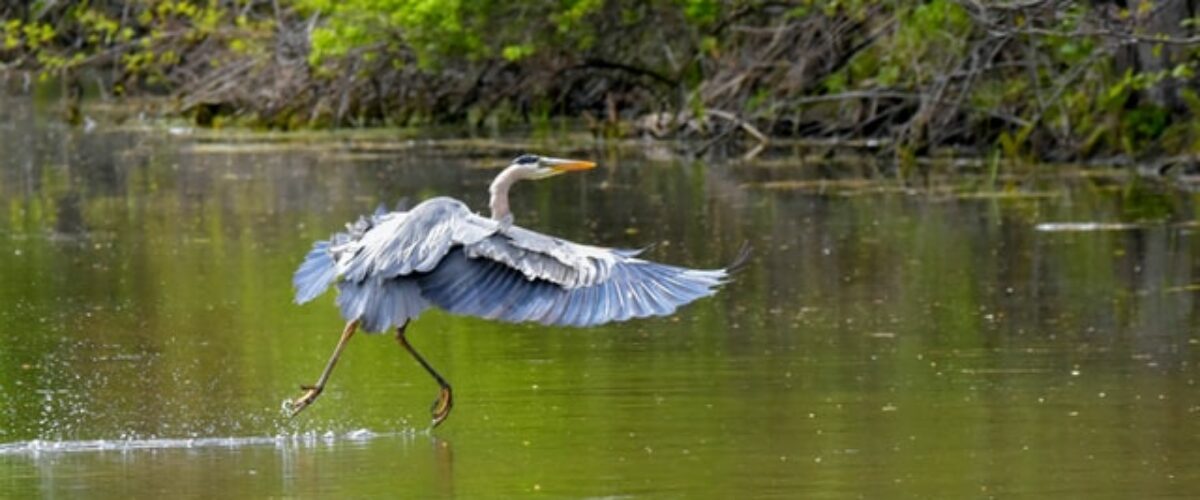
As you walk along the banks of the Eno River, it is common to see a Great Blue Heron standing stock still in the water. Its eyes are constantly scanning the murky depths of the river, searching for flickers of light reflecting from fish scales. Suddenly, its head shoots down into the water! It pulls out a catfish for its next meal.
Great Blue Herons are the largest species of heron in North America, with a height of around 4.5 feet and an impressive wingspan of 6.5 feet! They are known for their blue-gray feathers and a bold, black stripe over the eye of the adults. Their beak is bright yellow and shaped like a spear point.
These beautiful birds are found throughout North Carolina. From the Piedmont to the Outer Banks, Great Blue Herons will take to any shallow waters where prey is abundant. They prefer to hunt for fish but snakes, frogs, salamanders, small rodents, turtles, and even other birds are all fair game. Hunting at night is not a problem for these birds due to the high amount of rod-type photoreceptors in their eyes. Great Blue Herons will build large nests in the treetops from sticks and debris. They lay 3 to 5 eggs that hatch within a month.
In most cases herons are silent, but if you startle one they will take flight and call out with a loud croak!
We were lucky enough to find an adolescent Great Blue Heron standing on the ice of the Eno mill race. Perhaps it had found a hole to catch some fish through. In the coming months we hope to see more herons during our 2022 spring camp session.
As the end of winter approaches, more animals will be active. Head out on a hike — you might be surprised what you find!
Outdoor recreation and education have a special place in the hearts of humans across the globe. For some, the outdoor spaces that we know and love have always been a free and open place where they can get together and be themselves in nature. However, Black History Month serves as a reminder that many outdoor spaces have not always been free and open places where everyone can gather.
Through history, nonwhite communities were driven away from national parks, state parks, and other places of recreation as a result of discriminatory laws and institutional racism. Though these inequities have had lasting effects, we are now seeing some powerful and inspiring stories as a social movement is working to create strong and healthy relationships between nonwhite folks and the outdoors.
In the 1800s, the great outdoors was romanticized as a place where one could enjoy a breath of fresh air, away from cities inhabited by the many immigrants and people of color. The National Parks Service was founded in 1916; by then, Jim Crow laws, local ordinances, and other racist customs made Black communities unwelcome in parks. Even with the official desegregation of those parks in 1945, little change was seen. In some cases, segregation allowed Black people to be present only in a certain park area — spaces which were often developed with little effort. In fact, our very own Umstead State Park was segregated until 1966.
By 1952, 180 state parks throughout nine states were available to White people. At that same time, only 12 parks allowed Black people. Both implicit and explicit racism still occur in our parks and other places intended for the shared enjoyment of nature, raising serious safety concerns in these spaces. Generations of Black families grew up without safe and equitable access to nature, and even as laws changed and the world began a slow and ongoing road to heal from racism, Black communities still make up a disproportionate minority of parkgoers, as well as National Parks employees. Driven in part by the recent Black Lives Matter protests, in the past few years a social movement has gained momentum in changing the future for Black people in the outdoors.
A Virginia based organization, Black Girls Hike, was founded in 2020 for women of color who want to adventure together in the outdoors. Black Outside is another incredible non-profit that has emerged. “We intentionally craft experiences that build off of the powerful history of people of color in the outdoors and deepen the leadership skills of our youth,” says a quote from their website, explaining the important work they have been doing. Groups like Black Outside, Full Circle Everest, Black Girls Hike, and Outdoor Afro have created welcoming opportunities for people of color to get together to experience the many natural spaces of recreation and view them as places where everyone belongs.
It is true of many things — and outdoor recreation is no exception — that we still have substantial work to do to counter generations of exclusion. The Atlantic outlined a road map for change, which outlines steps that parks can take to create more accessible spaces for all. “Ultimately,” they say, “the parks belong to the public, and anyone can become an advocate of diversity.”
This Black History Month, we encourage you to learn more about the history of your favorite green spaces.
We’re now hiring for summer 2022 positions across all three sites. If you or someone you know wants to end each work day dirty, tired, and happy, you can learn more and apply here.
We’re also thrilled to have added several kind, curious, confident humans to our fabulous program team! Please join us in extending a warm welcome to these folks:
Rebeca Franca | Program Director
Maya Marin | Orange County Site Manager
William Stahura | Lead Camp Counselor
Aly Topscher | Lead Camp Counselor
[button url=”https://schoolhouseofwonder.org/join-our-team/employment/” text=”Learn More” style=”closed” color=”orange”]